Help Centre › Checklists › LSA and FFE
Template
Weekly LSA and FFE Checklist
by The Muster App
The weekly inspection of a vessel’s life-saving appliances and fire-fighting equipment under SOLAS III/20.6 and MSC.1/Circ.1432: survival craft and launching appliances, the rescue boat engine run, the general alarm and PA, the fire detection and fixed gas panels, and breathing apparatus. With the regulation behind every check.
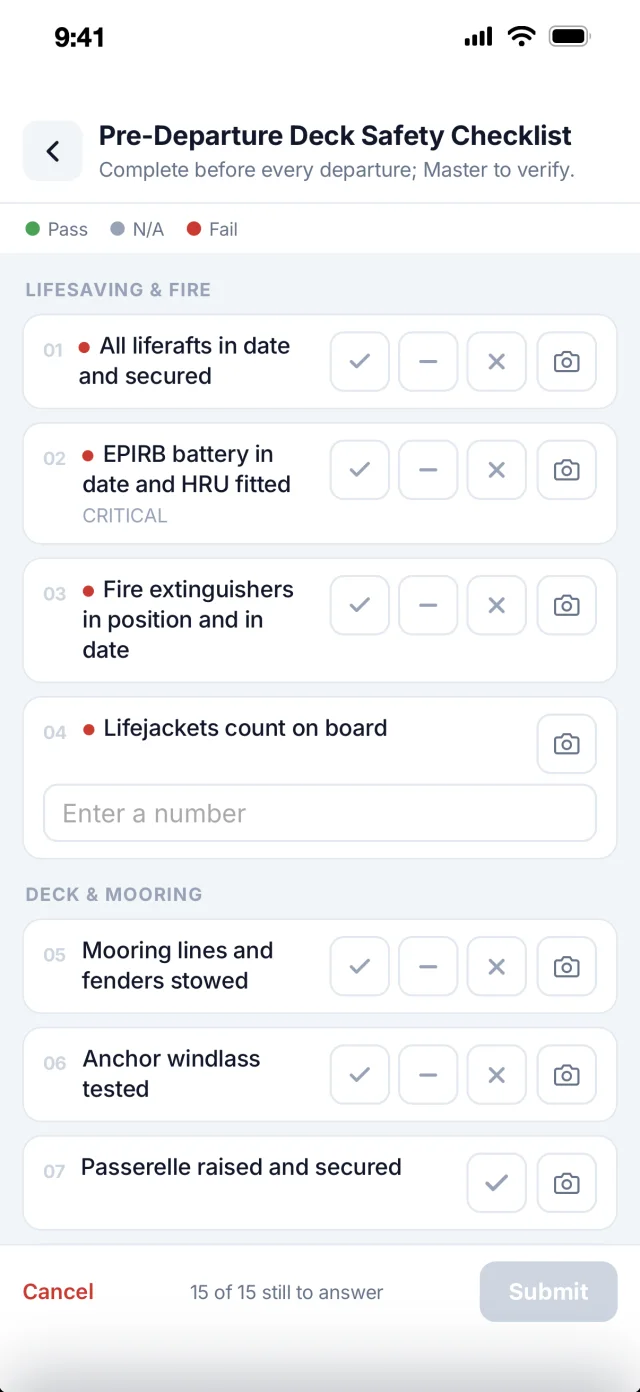
With The Muster App you can
- Run it on every crew phone and the bridge iPad
- Add a photo and a note to every fail
- Import your own checklists with AI
- Send failed checks to the Worklist, with a due date
- Keep a signed record of every round and every fix

Every check on the weekly round.
Every check with the regulation behind it. Print it, or run it on the phones.
Survival craft
SOLAS III/20.6.1- Liferafts and survival craft
Container intact, bands and lashings secure; hydrostatic release unit correctly rigged, painter on the weak link and made fast to the vessel; release unit and liferaft service dates in date; float-free path clear.
SOLAS III/20.6.1, III/20.8, III/20.9Liferaft service dueHRU expiry - Lifeboats
Hooks, attachment and on-load release gear reset; engine run for at least 3 minutes with the gearbox engaged; moved from stowage far enough to prove the launching appliance, with no one aboard. If fitted.
SOLAS III/20.6.1, III/20.6.3
Rescue boat and launching appliances
SOLAS III/20.6.1, III/20.6.2- Rescue boat
Hull sound or tubes firm and ready to launch; release hook reset with the safety pin in place, bridle and lifting points sound; fuel full, kill cord fitted, start battery charged; equipment stowed.
SOLAS III/20.6.1 - Rescue boat engine run
Run for at least 3 minutes with the gearbox engaged ahead and astern; cooling water flowing, no leaks. An outboard may run on a suitable water supply.
SOLAS III/20.6.2Run time (min) - Launching appliances and release gear
Davit or crane structure, falls at the sheaves, hooks and their attachment free of damage; on-load release gear properly and completely reset; controls and limit switches working; emergency or manual means of launching available.
SOLAS III/20.6.1, III/20.4
Alarms and communications
SOLAS III/20.6.4- General emergency alarm
Sounded from the bridge on the alarm itself, not a lamp test, with the crew warned first. Heard in this week's zone, rotating so every zone is covered each month; visual indicators in noisy spaces working.
SOLAS III/20.6.4Zone tested - Public address system
Announcement heard in this week's zones from each PA station; amplifier free of faults.
MSC.1/Circ.1432 4.4Zones tested
Fire detection and fire doors
MSC.1/Circ.1432 4.1, 4.3, 4.6- Fire detection and alarm panel
Lamp and indicator test passed; no faults or isolated zones left unexplained; repeater panels match the main panel.
MSC.1/Circ.1432 4.1Zones isolated - Fire door control panel
Lamp test passed; every door shown in the correct state. If fitted.
MSC.1/Circ.1432 4.3 - Low-location lighting
With normal lighting off in this week's area, the lighting shows the escape route and the exits are marked. If fitted.
MSC.1/Circ.1432 4.6
Fixed fire-fighting systems
MSC.1/Circ.1432 4.2, 4.7- Fixed gas system control panel
Lamp and indicator test passed on the CO2, FM-200 or Novec panel; release cabinet closed and sealed.
MSC.1/Circ.1432 4.2.1 - Fixed gas system valves
Control and section valves in the correct position.
MSC.1/Circ.1432 4.2.2 - Water mist or sprinkler system
Panel indicators and alarms working; pump unit and fittings sound; unlocked pump valves in the correct position. If fitted.
MSC.1/Circ.1432 4.7
Breathing apparatus
MSC.1/Circ.1432 4.5- Breathing apparatus and EEBDs
Cylinder pressure in range and the set holds pressure; mask clean, straps extended; spare cylinders charged; each EEBD in its stowage with the seal intact and the gauge in range.
MSC.1/Circ.1432 4.5Lowest cylinder pressure (bar)
Emergency systems
If fitted- Watertight doors
Closed and opened locally and remotely; position indication on the bridge correct; alarm sounds on closing; seals and dogs sound.
SOLAS II-1/21.1 - Emergency generator
Started and run on load; fuel, oil and coolant levels correct; start battery and charger in order.
Run time (min) - Emergency fire pump
Started from its remote position and delivering water to the fire main.
Pressure (bar)
Battery-powered equipment
MCA MGN 681- Lithium-ion batteries
Battery-powered craft, tools and equipment: no swelling, damage or leaks; stowed and charged in the assigned space; damaged units taken off charge and isolated.
MCA MGN 681
When a check fails, it gets fixed.
A tick sheet says the round happened. This says what was wrong and who fixed it.
Emergency fire pump not reaching pressure. Engineer informed.
Notes and photos
On every fail, kept with the check.
Worklist
Every failed check becomes a task, assigned with a due date.
Impeller replaced, pump retested.
Corrective action history
What was done, who did it and when, on the signed record.
What SOLAS asks for.
Where the weekly checks come from
SOLAS Chapter III, Regulation 20 is titled Operational readiness, maintenance and inspection, and paragraph 20.6 sets out what happens every week: a visual inspection of survival craft, rescue boats and launching appliances; all lifeboat and rescue boat engines run for a total of not less than three minutes; on cargo ships, lifeboats moved from their stowed position where weather allows; and the general emergency alarm tested.
The three minutes is the part crews most often get wrong, in both directions. It is a total, not three minutes per attempt, and it is conditional on ambient temperature.
The monthly inspection and the regulation 36 checklist
Paragraph 20.7 covers the month. Life-saving appliances are inspected monthly using the checklist required by regulation 36.1, and a report goes in the log book. That checklist comes from the manufacturers’ manuals and the vessel’s safety management system, so an inspector asks to see the checklist first and the completed records second.
The fire side: SOLAS II-2/14
Regulation 14 requires fire protection systems and appliances to be kept ready for immediate use, and a maintenance plan kept on board. MSC.1/Circ.1432 sets the intervals. Weekly: the fire detection and fixed gas panel lamp tests, the fixed gas valves, the PA and general alarm, and breathing apparatus and EEBD gauges. Hydrants and hoses, the fire pumps and the fixed gas cylinders are monthly; portable extinguishers follow the maker’s intervals and are serviced at least once a year.
Who has to supervise
Weekly and monthly inspections of survival craft, rescue boats and launching appliances are done by the crew under the direction of a senior officer (Res. MSC.402(96)). On a yacht that is usually the chief officer. If the record shows only the deckhand who walked round, that direction is not evidenced.
What the record has to show
- What was checked, item by item
- When, with enough of the time to show the interval was kept
- Who completed it, and which senior officer supervised
- What was wrong, and what happened next
LSA and FFE checklists, answered.
What is an LSA and FFE checklist?
The inspection record for the vessel’s life-saving appliances and fire-fighting equipment. SOLAS sets a weekly inspection (III/20.6) and a monthly one (III/20.7), and MSC.1/Circ.1432 sets the intervals for the fire equipment.
How often do LSA and FFE checks happen?
Weekly for the round on this page, monthly for the full LSA inspection against the regulation 36.1 checklist, and at the servicing intervals your contractors set.
What happens when a check fails?
It goes on the Worklist as a task, assigned to a crew member with a due date. When it is marked done, what was done goes on the signed record. If the check is critical, the captain and heads of department are told on their phones.
Can I change it for my boat?
Yes. In the app every check can be edited, moved, marked critical or given a photo requirement, and your version is the one the crew run.
Can I use it on paper?
Yes. Download the PDF and print it.
What does it cost?
The checklist is free. Running it in The Muster App is included in Pro. Free for 14 days. See pricing
Download the checklist
The Weekly LSA and FFE Checklist as a PDF, ready to print.
We only email you if you tick the box. Privacy policyYour checklist is downloading.
If it doesn’t start, download it here.