Help Centre › Checklists › Monthly LSA and FFE
Template
Monthly LSA and FFE Checklist
by The Muster App
The monthly inspection of a vessel’s life-saving appliances and fire-fighting equipment under SOLAS III/20.7 and III/36 and MSC.1/Circ.1432: liferafts and HRUs, lifebuoys, lifejackets, immersion suits and pyrotechnics, the hydrants and fire pumps, the fixed gas cylinders and the firefighter’s outfits. With the regulation behind every check.
With The Muster App you can
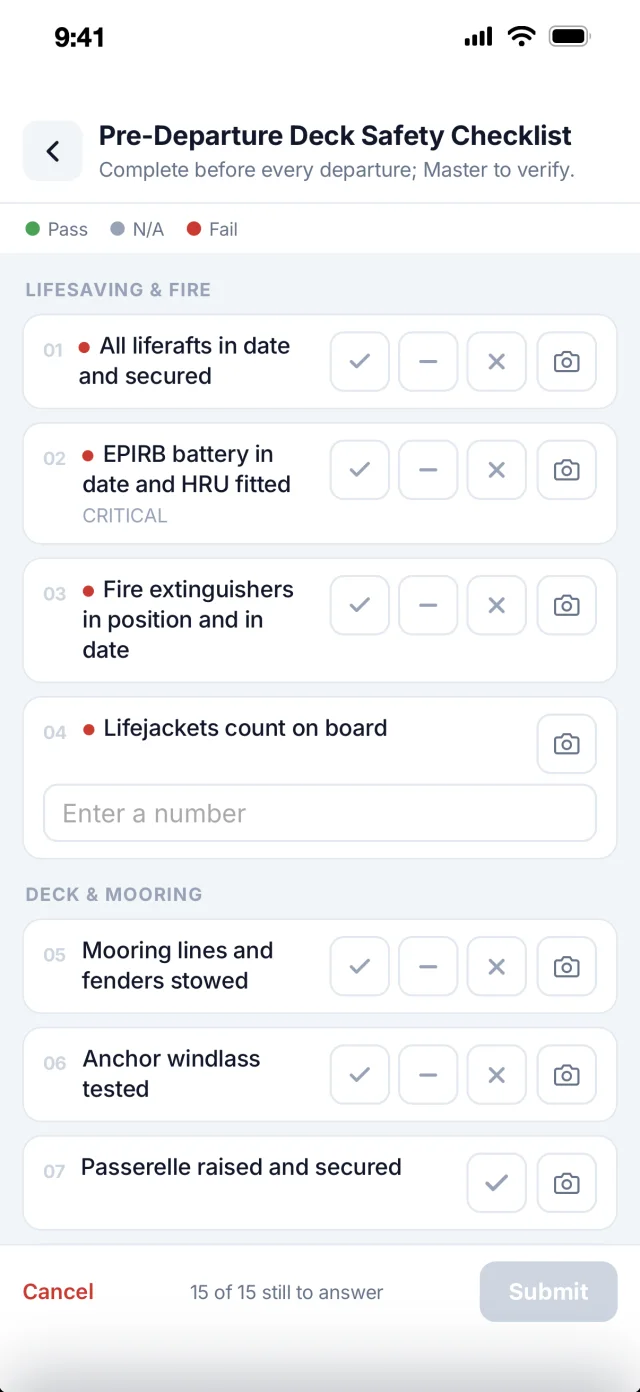
- Run it on every crew phone and the bridge iPad
- Add a photo and a note to every fail
- Import your own checklists with AI
- Send failed checks to the Worklist, with a due date
- Keep a signed record of every round and every fix

Every check on the monthly round.
Every check with the regulation behind it. Print it, or run it on the phones.
Survival craft
SOLAS III/20.7- Liferafts and HRUs
All weekly checks, plus number and stowage correct and the IMO symbols marked; liferaft service and release unit expiry in date; painter attached to the weak link.
SOLAS III/20.7.2, III/20.8Liferaft service dueHRU expiry - Embarkation arrangements
Embarkation ladder or evacuation system at each station secured and ready; route clear for liferafts moved from side to side; muster and embarkation signage in good order.
SOLAS III/20.7.2 - Lifeboats turned out
Turned out from stowage with no one aboard, weather permitting; equipment checked against the inventory. If fitted.
SOLAS III/20.7.1
Personal life-saving appliances
SOLAS III/20.7.2- Lifebuoys
Self-igniting light working and in date; smoke signal in date and attached; buoyant line sound and free of tangles; marked with the vessel's name and port of registry, reflective tape intact; bridge quick-release free.
SOLAS III/20.7.2Earliest light or smoke expiry - Lifejackets
Counted at each station against persons on board, including child and infant sizes; every lifejacket has a working light and whistle, light in date; inflatables' cylinders tight and service in date; stowage signed.
SOLAS III/20.7.2AdultChildInfantEarliest light expiry - Immersion suits and TPAs
Bag sound and size marked; suit dry and undamaged; zip runs freely and is lubricated; reflective tape intact; light, battery and whistle in date; repacked with the zip open.
MSC/Circ.1047Suits countedEarliest light expiry
Distress signals and line-throwing
SOLAS III/20.7.2, III/18- Pyrotechnics
Parachute rockets, hand flares and smoke signals counted against the required number, all in date and stowed dry with instructions legible.
SOLAS III/20.7.2Rocket parachute flaresHand flaresSmoke signalsEarliest expiry - Line-throwing appliance
Four projectiles and four lines present and in date; stowage and instructions in order.
SOLAS III/18Expiry
Rescue boat
SOLAS III/20.7.2, III/19.3.4.6- Rescue boat equipment
Full inventory against the boat's equipment list; lifejackets and immersion suits for the boat's crew; pump, paddles, knife, torch and first-aid kit present and in date.
SOLAS III/20.7.2, III/36.1 - Rescue boat launched
Launched with its assigned crew, manoeuvred in the water, then recovered and reset; at least every 3 months.
SOLAS III/19.3.4.6Date launched
Muster and recovery
SOLAS III/17-1, III/19.3.4.9- Muster and embarkation lighting
Lighting at muster stations, survival craft, launching areas and over the side working on the emergency supply; routes to the muster stations lit.
SOLAS III/19.3.4.9 - Man overboard recovery
Recovery equipment named in the vessel's plan present and ready; boarding ladder or net reaches below the waterline; rescue lines and boat hook in place.
SOLAS III/17-1
Radio life-saving appliances
SOLAS IV- EPIRB, SARTs and handheld VHF
EPIRB self-test passed, release unit and battery in date, registration current; SART self-test seen on radar or AIS, battery in date; handheld VHF test call on a working channel, sealed battery in date.
EPIRB battery expiryEPIRB HRU expirySART battery expiry
Fire main
MSC.1/Circ.1432 5.1- Hydrants, hoses and nozzles
Valve opens and closes; hose connected where required, flaked and undamaged, coupling seal present; nozzle jet, spray and shut-off working; coupling key with it.
MSC.1/Circ.1432 5.1.1 - Fire pumps
Every fire pump run and delivering adequate pressure at the main; isolating valves accessible.
MSC.1/Circ.1432 5.1.2Lowest pump pressure (bar) - Emergency fire pump
Started from its remote position; fuel supply adequate; heating in order where fitted.
MSC.1/Circ.1432 5.1.2, 5.1.3Fuel level (%)
Fixed fire-fighting systems
MSC.1/Circ.1432 5.2 to 5.7- Fixed gas system cylinders
Stop valves closed; release controls in position and accessible; piping undamaged; cylinders secured with gauges in range and no leakage; alarms in place. Low-pressure CO2: tank pressure and level correct.
MSC.1/Circ.1432 5.2, MSC.1/Circ.1318/Rev.1 4.1 - Water mist or sprinkler system
Control, pump and section valves in position; pressure tank and water levels correct; pump auto-start tested; a sample section valve flow-tested with the alarm received, so every valve is tested within a year. If fitted.
MSC.1/Circ.1432 5.4Section valve tested - Foam, dry powder or aerosol systems
Valves in position and gauges in range; aerosol control circuits in order. If fitted.
MSC.1/Circ.1432 5.3, 5.6, 5.7
Fire detection
MSC.1/Circ.1432 5.10- Detectors and manual call points
This month's sample tested, so every detector and call point is tested within five years; detectors clean and unobstructed, call point covers intact.
MSC.1/Circ.1432 5.10Devices tested
Firefighting equipment
MSC.1/Circ.1432 5.5, 5.8, 5.9- Firefighter's outfits
Suit, boots, gloves, helmet, lamp, axe and lifeline complete; breathing apparatus complete with charged spare cylinders; fire party radios charged and tested.
MSC.1/Circ.1432 5.5 - Portable extinguishers
In place, unobstructed and in date; pin and seal intact, gauge in range; no damage or corrosion; spare charges carried.
Next service due - Wheeled extinguishers and foam applicators
In place, properly arranged and in good condition. If fitted.
MSC.1/Circ.1432 5.8, 5.9 - Smoke hoods
In place at each position, packaging sealed and in date.
Galley and machinery spaces
If fitted- Galley fire protection
Fire blanket in place; wet-chemical extinguisher or fixed fryer system gauge in range, nozzles capped, manual release clear; fryer isolation within reach.
SOLAS II-2/10.6.4 - Fuel quick-closing valves and emergency stops
Remote closing stations accessible and labelled, wires or air supply in order; fan and fuel pump emergency stops guarded, labelled and unobstructed.
- Tender garage and fuel locker
Fixed fire protection isolating valve accessible and in position; extraction fans running with the airflow alarm healthy; drains clear; petrol in marked, secured containers; fuel locker vents clear with an extinguisher beside it. If fitted.
When a check fails, it gets fixed.
A tick sheet says the round happened. This says what was wrong and who fixed it.
Emergency fire pump not reaching pressure. Engineer informed.
Notes and photos
On every fail, kept with the check.
Worklist
Every failed check becomes a task, assigned with a due date.
Impeller replaced, pump retested.
Corrective action history
What was done, who did it and when, on the signed record.
What SOLAS asks for.
Where the weekly checks come from
SOLAS Chapter III, Regulation 20 is titled Operational readiness, maintenance and inspection, and paragraph 20.6 sets out what happens every week: a visual inspection of survival craft, rescue boats and launching appliances; all lifeboat and rescue boat engines run for a total of not less than three minutes; on cargo ships, lifeboats moved from their stowed position where weather allows; and the general emergency alarm tested.
The three minutes is the part crews most often get wrong, in both directions. It is a total, not three minutes per attempt, and it is conditional on ambient temperature.
The monthly inspection and the regulation 36 checklist
Paragraph 20.7 covers the month. Life-saving appliances are inspected monthly using the checklist required by regulation 36.1, and a report goes in the log book. That checklist comes from the manufacturers’ manuals and the vessel’s safety management system, so an inspector asks to see the checklist first and the completed records second.
The fire side: SOLAS II-2/14
Regulation 14 requires fire protection systems and appliances to be kept ready for immediate use, and a maintenance plan kept on board. MSC.1/Circ.1432 sets the intervals. Weekly: the fire detection and fixed gas panel lamp tests, the fixed gas valves, the PA and general alarm, and breathing apparatus and EEBD gauges. Hydrants and hoses, the fire pumps and the fixed gas cylinders are monthly; portable extinguishers follow the maker’s intervals and are serviced at least once a year.
Who has to supervise
Weekly and monthly inspections of survival craft, rescue boats and launching appliances are done by the crew under the direction of a senior officer (Res. MSC.402(96)). On a yacht that is usually the chief officer. If the record shows only the deckhand who walked round, that direction is not evidenced.
What the record has to show
- What was checked, item by item
- When, with enough of the time to show the interval was kept
- Who completed it, and which senior officer supervised
- What was wrong, and what happened next
LSA and FFE checklists, answered.
What is an LSA and FFE checklist?
The inspection record for the vessel’s life-saving appliances and fire-fighting equipment. SOLAS sets a weekly inspection (III/20.6) and a monthly one (III/20.7), and MSC.1/Circ.1432 sets the intervals for the fire equipment.
How often do LSA and FFE checks happen?
Weekly for the inspection under SOLAS III/20.6, monthly for the one on this page against the regulation 36 checklist, and at the servicing intervals your contractors set.
What happens when a check fails?
It goes on the Worklist as a task, assigned to a crew member with a due date. When it is marked done, what was done goes on the signed record. If the check is critical, the captain and heads of department are told on their phones.
Can I change it for my boat?
Yes. In the app every check can be edited, moved, marked critical or given a photo requirement, and your version is the one the crew run.
Can I use it on paper?
Yes. Download the PDF and print it.
What does it cost?
The checklist is free. Running it in The Muster App is included in Pro. Free for 14 days. See pricing
Download the checklist
The Monthly LSA and FFE Checklist as a PDF, ready to print.
We only email you if you tick the box. Privacy policyYour checklist is downloading.
If it doesn’t start, download it here.